- ads -
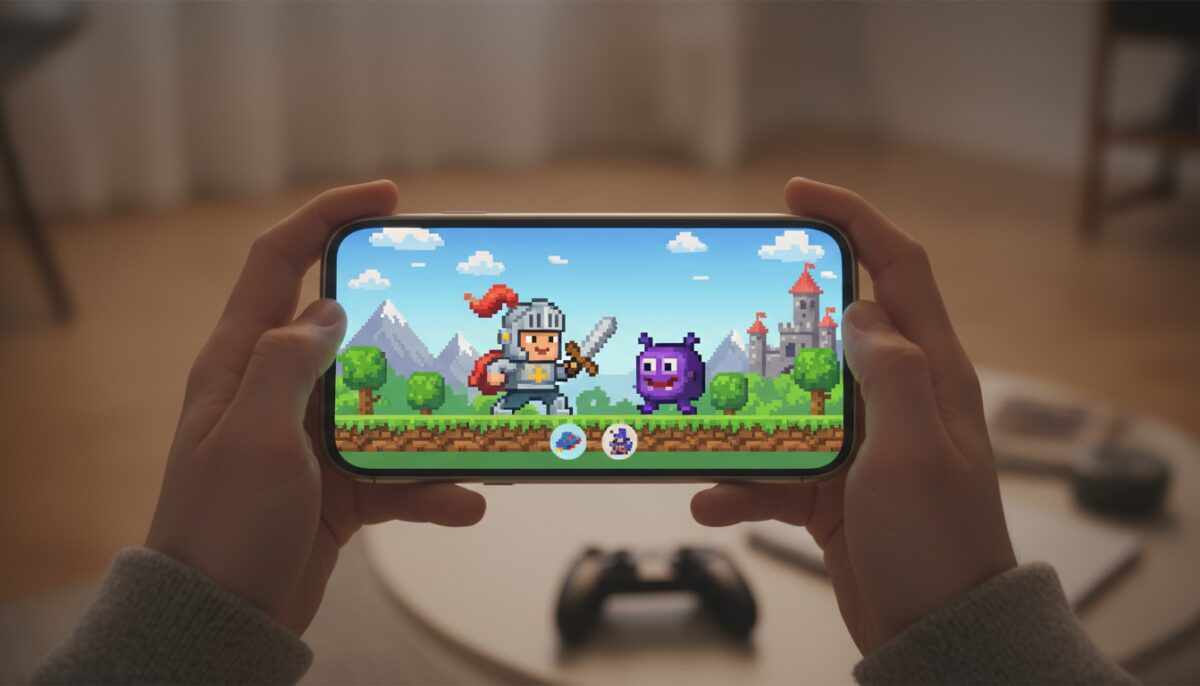
If you take a quick scroll through the App Store or Google Play charts today, you might feel like you’ve been transported back to 1992. Amidst the hyper-realistic graphics and 3D battle royales, there is a massive surge of pixel art, chiptune music, and side-scrolling action.
Retro-style games aren’t just surviving on modern smartphones; they are absolutely crushing it. But why are we so obsessed with “old-looking” games when we carry supercomputers in our pockets?
- ads -
As a mobile gaming enthusiast, I’ve watched this trend evolve from a niche indie movement into a global powerhouse. Let’s dive deep into why the 8-bit and 16-bit aesthetics are the perfect match for your smartphone.
The Power of Nostalgia in Your Pocket
Nostalgia is arguably the most powerful marketing tool in the world. For many of us, our first gaming experiences involved a Game Boy or a bulky console plugged into a CRT television.
- ads -
Seeing those chunky pixels on a modern OLED screen triggers a dopamine hit unlike anything else. It reminds us of simpler times when gameplay was king and microtransactions didn’t exist.
Developers know this. By mimicking the art styles of the 80s and 90s, they tap into a pre-existing emotional connection. It’s not just about looking old; it’s about feeling familiar in an increasingly complex digital world.
Perfect Performance on Any Device
One of the biggest hurdles for mobile gaming is hardware fragmentation. Not everyone owns the latest iPhone or a high-end gaming phone with a liquid cooling system.
Retro-style games solve this problem beautifully. Because they rely on 2D sprites and optimized code, they can run smoothly on almost any device, from a budget smartphone to a flagship tablet.
This accessibility means a larger player base. Developers don’t have to worry about their game lagging on a three-year-old phone, ensuring that the user experience remains consistent for everyone.
Battery Life and Portability
Let’s be honest: high-end 3D games absolutely murder your battery. Playing a graphically intensive shooter for thirty minutes can leave you hunting for a charger by noon.
Retro games are incredibly energy-efficient. You can play a pixel-art RPG for hours during a long commute without seeing your battery percentage plummet into the red zone.
The “Pick Up and Play” Nature of Retro Design
Modern AAA mobile games often come with steep learning curves, long tutorials, and complex control schemes that require a dedicated controller to enjoy properly.
In contrast, retro-style games are built on the philosophy of instant accessibility. Most of these titles use simple layouts: a D-pad and a couple of buttons, or even just one-touch controls.
This “pick up and play” nature is exactly what mobile gamers want. Whether you’re waiting for the bus or standing in line at the grocery store, you can jump into a quick level and feel a sense of progress.
Case Study: Vampire Survivors
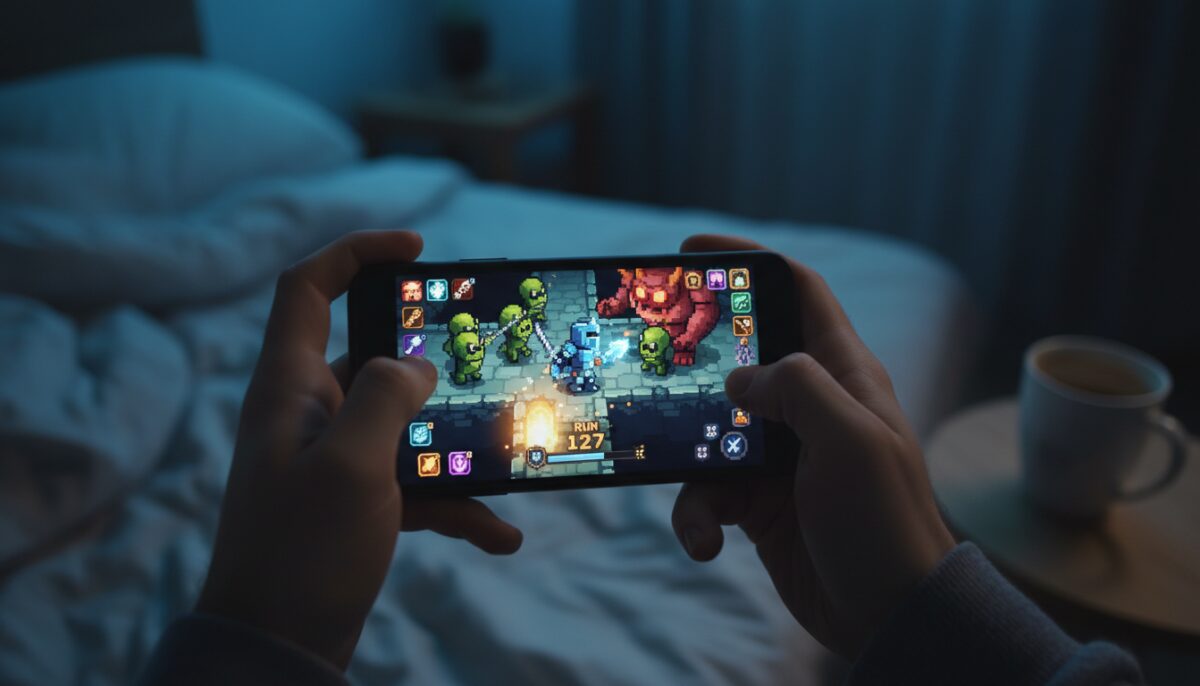
If you want to see this trend in action, look no further than Vampire Survivors. This game became a global phenomenon despite (or perhaps because of) its incredibly simple graphics.
The game uses basic sprites that look like they were pulled straight from a Gothic NES title. There is no manual aiming; you simply move your character while they auto-attack waves of enemies.
It’s addictive, it’s chaotic, and it runs perfectly on mobile. It proves that gameplay loops and satisfying progression are far more important than high-polygon counts.
The Pros and Cons of Retro Gaming on Mobile
While the trend is overwhelmingly positive, it’s worth looking at both sides of the coin to understand why some players love it and others might be hesitant.
- Pro: Instant Loading Times. No more waiting for 2GB of assets to load before you can see the main menu.
- Pro: Smaller File Sizes. You can fit dozens of retro games in the space it takes to download one “realistic” open-world game.
- Pro: Creative Freedom. Indie developers can focus on unique mechanics rather than spending millions on realistic hair physics.
- Con: Control Limitations. Some retro ports struggle with touchscreens if the original game required precise physical buttons.
- Con: Market Saturation. Because they are easier to make, the store is often flooded with low-quality “asset flips.”
Artistic Expression Beyond Realism
We are currently living in an era where “realism” has reached a point of diminishing returns. When every game looks like a movie, they all start to look the same.
Retro styles allow for bold artistic choices. Games like Stardew Valley or Terraria use pixel art to create vibrant, atmospheric worlds that feel alive and distinct.
Pixel art is a legitimate art form, not just a limitation. The way a developer uses color palettes and shading in a 16-bit style can convey more emotion than a 4K facial animation ever could.
The Rise of “Neo-Retro”
We are also seeing the rise of “Neo-Retro”—games that look old but utilize modern lighting, physics, and particle effects that would have been impossible on original hardware.
This hybrid approach gives us the best of both worlds: the charm of the past with the smoothness and technical depth of the present.
Financial Viability for Indie Developers
The mobile market is notoriously difficult to break into. For a small indie team, creating a high-fidelity 3D game is often financially impossible.
By choosing a retro aesthetic, developers can allocate their limited budget toward polish, sound design, and deep gameplay mechanics. This has led to a golden age of indie hits on mobile.
When the development cost is lower, the risk is lower. This allows creators to experiment with weird and wonderful ideas that big studios wouldn’t touch. This innovation keeps the mobile ecosystem fresh.
Social Connectivity and Competitive Retro
Modern smartphones have turned retro gaming into a social experience. Features like global leaderboards, cloud saves, and screen recording make it easy to share your high scores.
Games like Pac-Man 256 or Crossy Road took classic concepts and added social hooks that keep players coming back daily to beat their friends’ scores.
This blend of old-school challenge and modern social features is a winning formula. It satisfies the competitive itch without requiring a 40-minute commitment for a single match.
The Role of Emulation and Official Ports
We cannot talk about retro gaming on mobile without mentioning official ports. Companies like SEGA, Capcom, and Square Enix have realized the goldmine they are sitting on.
Bringing classics like Sonic the Hedgehog, Castlevania: Symphony of the Night, or the early Final Fantasy games to mobile has been a massive success.
These aren’t just games; they are cultural milestones. Having the ability to play a perfect version of a game that defined your childhood on a device that fits in your pocket is a miracle of modern technology.
Improving on the Past
Many of these modern ports include “Quality of Life” improvements. Features like save states, rewind buttons, and customizable touch controls make these challenging older games more palatable for a modern audience.
Hardware Support: Making Retro Feel Right
While touchscreens are great for casual play, the explosion of mobile gaming controllers (like the Backbone One or Razer Kishi) has changed the game for retro enthusiasts.
When you snap your phone into a physical controller, it essentially becomes a “Retro Console Pro.” This hardware support has encouraged developers to release more complex retro-style titles.
This synergy between hardware and software has solidified the smartphone as the ultimate platform for retro gaming, even surpassing dedicated handhelds in some aspects.
Why the Trend Isn’t Going Anywhere
Some critics argued that the retro trend was a fad that would die out once mobile hardware became powerful enough to handle “real” games. They were wrong.
Retro gaming isn’t a fallback plan; it’s a deliberate stylistic choice. As our lives get busier and our attention spans get shorter, the efficiency of retro design becomes even more valuable.
We are also seeing a new generation of gamers—Gen Z and Gen Alpha—discovering these styles for the first time. To them, pixel art isn’t “old”; it’s just a cool aesthetic they see in Minecraft and Roblox.
Top 5 Retro-Style Games You Should Play Right Now
- Dead Cells: A punishingly difficult “Rogue-lite” with incredible pixel animations and fluid combat.
- Stardew Valley: The ultimate farming simulator that captures the magic of the SNES era with modern depth.
- Horizon Chase: A love letter to 90s arcade racers like OutRun, featuring vibrant colors and a killer soundtrack.
- Shovel Knight: A masterpiece of 8-bit design that feels like the best NES game that was never actually made.
- Retro Bowl: A stylized American football game that proves you don’t need realistic graphics to have a deep sports sim.
Conclusion: The Future is Pixelated
The success of retro-style games on smartphones is a testament to the fact that good design is timeless. It’s a marriage of nostalgia, technical efficiency, and pure, unadulterated fun.
Modern smartphones have provided the perfect canvas for these games to thrive. They offer the screen quality to make pixels pop and the connectivity to make old-school challenges social again.
Whether you’re a veteran gamer looking to relive your glory days or a newcomer searching for a game that doesn’t require a manual, the retro revolution has something for you.
So, the next time you browse the app store, don’t be afraid to go for the “low-res” option. You might find that those little squares of color offer more heart and soul than the biggest blockbuster titles on the market.
Retro isn’t just about looking back; it’s about taking the best parts of gaming history and carrying them forward into the palm of our hands. Long live the pixel!